One AI agent made 18,834 payments. The total was $172.78
PayAI says Kognai used a reusable Solana payment channel for thousands of sub-cent paid calls. The count is reported, not independently reconstructed.
Article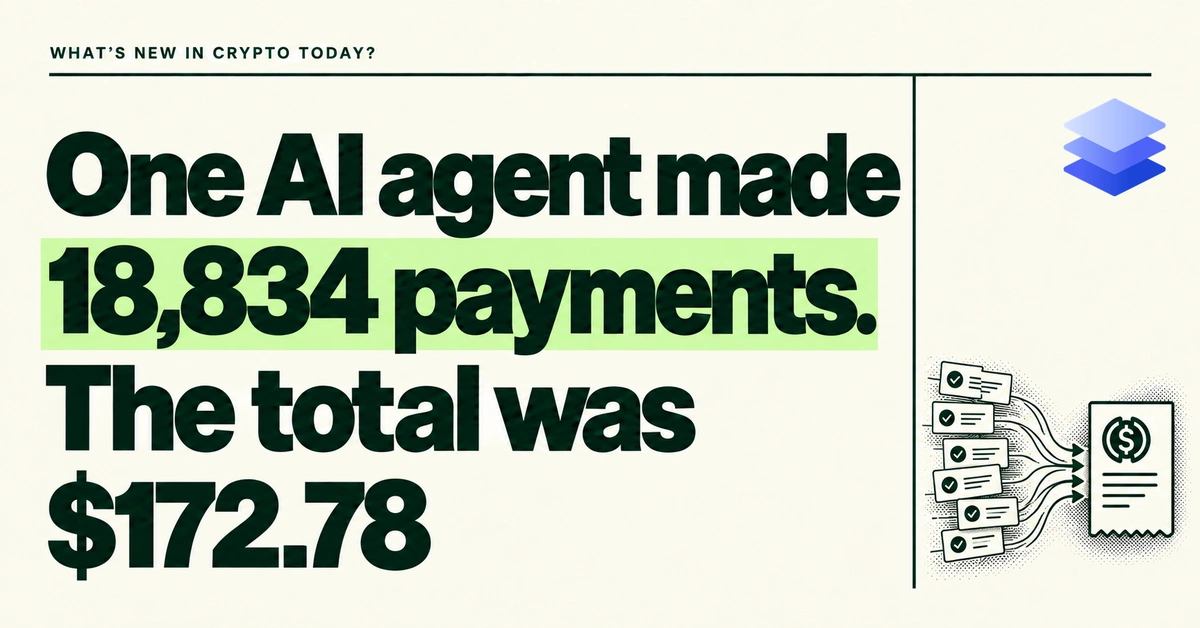
PayAI says one Kognai workload made 18,834 payments worth 172.78 USDC over two weeks.
That works out to about $0.0092 per payment.
The number is useful because it describes the kind of machine-priced work that ordinary payment rails struggle to serve. A charge below one cent cannot carry the cost and delay of a separate blockchain settlement every time.
PayAI’s answer is a reusable payment channel on Solana.
The operating count comes from PayAI and has not been independently reconstructed from transaction-level records. The payment design itself is documented by PayAI and the x402 Foundation.
Thousands of payments, fewer settlements
A customer first funds a channel with USDC. The channel holds a balance that can pay for many requests.
For each paid call, the customer supplies an amount-bounded authorization. The merchant signs a cumulative voucher that increases the total amount owed. Those steady-state requests do not need a new onchain transaction every time.
Later, the merchant claims the accumulated amount. The facilitator then distributes USDC to the merchant’s token account.
This distinction is the point of batch settlement. The economic activity can be measured request by request while the blockchain work happens less often.
Two weeks of Kognai on x402: 18,834 payments and 172.78 USDC. PayAI says the average payment was below one cent.
PayAI · October 17, 2026
Why a $0.009 payment matters
An agentic payment system is useful only if its payment overhead is small relative to the thing being bought.
If an AI agent buys one inference, data lookup or API result for less than one cent, a separate settlement for every request can dominate the cost. It can also slow a workload that needs many calls in sequence.
Batch settlement changes that ratio. One funded channel can support many paid calls before the merchant collects the money.
Using PayAI’s totals, Kognai’s reported average was:
172.78 USDC ÷ 18,834 payments = 0.00917 USDC per payment
The average does not mean every call cost the same amount. It shows that the workload was operating at a scale where sub-cent pricing was normal, not exceptional.
The channel is not free of trust
The system reduces settlement frequency, but it introduces responsibilities for both sides.
In the documented server-signed mode, the merchant’s operator can sign cumulative charges up to the channel’s funded balance. The customer must explicitly allow that operator and cap the deposit held under it.
The customer authorization is a bearer credential during the channel’s lifetime. PayAI’s documentation says it should be protected like a secret.
The merchant also needs durable storage. It must retain channel state, payment operations and replayable responses. Payment storage alone does not guarantee that the underlying application runs exactly once.
A retried payment request could otherwise repeat the purchased action even when the payment layer avoids a duplicate settlement. The application still needs stable request keys and idempotent work.
A claim is not the final payout
PayAI makes another operational distinction explicit: a successful claim is not yet proof that the merchant received USDC.
After the claim, the distribution transaction must succeed. The merchant should verify that its USDC token-account balance increased by the expected amount and reconcile the transaction identity against its own records.
This matters when reported payment counts are used as activity metrics. Replayed operations should not be counted as new volume, and a successful HTTP response should not be treated as a new payment without transaction-level deduplication.
The service is still a public preview
PayAI currently describes its batch-settlement facilitator support as a public preview.
The documented shared lane:
- accepts initial channel deposits from 0.01 to 100 USDC
- limits open or closing channels to 10 per merchant identity
- has a service-wide sponsored capacity of 1,000 channels
- can pause new admission when capacity or sponsorship funds are unavailable
Those limits do not cap the number of requests inside an existing channel. They do show that the current service is not evidence of unlimited production capacity.
What traders and builders should watch
The Kognai report is stronger than another agent-payments announcement because it gives a count and value for a real workload.
The next evidence should go deeper:
- The number of channels behind the 18,834 payments.
- The distribution of payment sizes rather than only the average.
- Claim and distribution transactions tied to the reported period.
- Failed, retried and recovered requests.
- The cost difference versus exact settlement for every request.
- Whether Kognai continues paying after the initial two-week period.
The interesting number is not 18,834 by itself. It is 18,834 payments for only $172.78. That is the workload batch settlement was built to make economical.
Sources and reporting notes
Checked October 17, 2026. The Kognai operating figures come from PayAI’s report. Channel design, limits and operational warnings come from PayAI’s Solana batch-settlement guide and the x402 Foundation’s SVM batch-settlement specification. We did not independently reconstruct Kognai’s channel history or execute a paid request.