UBI now pairs launch tokens with gold
Traders still use USDC, but each trade routes through XAUm and can send tokenized-gold fees to holders, creators and buybacks.
Article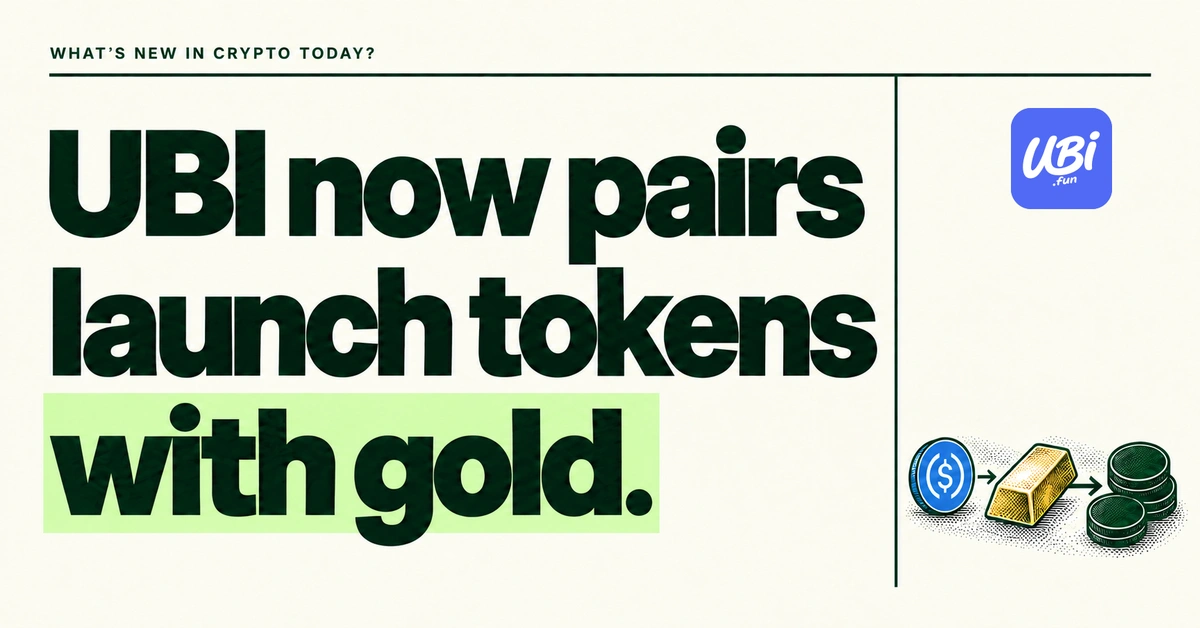
UBI has launched a new token model on Arc that pairs speculative launch tokens with XAUm tokenized gold instead of pairing them directly with USDC.
Traders still enter and exit with USDC. Behind the interface, each trade passes through gold first. Fees, creator earnings and holder distributions can therefore arrive in XAUm.
This does not make every launched token backed by gold. The gold token sits on the other side of its market. The launched token can still rise, collapse or lose liquidity on its own.
How one trade moves through gold
UBI V3 creates a fixed supply of 1 billion tokens and starts each market at a stated $10,000 market capitalization. The token trades against XAUm inside its own liquidity pool.
XAUm is tokenized gold issued by Matrixdock. The issuer says one XAUm represents one troy ounce of physical gold.
If a trader buys with USDC, UBI combines two swaps in one transaction:
- USDC buys XAUm through the XAUm and USDC pool.
- That XAUm buys the launch token through its own pool.
Selling reverses the route. The launch token becomes XAUm, then the XAUm becomes USDC.
The quote includes both markets, so a trader pays for price impact in the gold pool and the token pool. A large sale can also return some XAUm directly if the gold-to-USDC pool cannot absorb the entire amount at once.
Gold flows into the fee system
Creators choose separate buy and sell fees between 1.5% and 5%. They can also enable an early anti-snipe fee that starts as high as 60% and declines to the normal buy fee over no more than ten minutes.
Those settings matter because the fee is the engine of the product.
UBI’s initial V3 split sends 77% to the creator side, 13% to eligible UBI holders and 10% to the protocol. The creator can redirect part of its stream to token holders and automatic token buybacks, which use trading proceeds to purchase the launch token.
The buyback setting can receive as much as 83% of the creator stream. It uses the pair asset to buy the launch token and permanently removes what it purchases from circulation.
That maximum is not the default, and it is not a guaranteed floor. A large percentage of small trading fees can still produce a small buyback.
The gold link adds another dependency
The feature gives traders a new route, but it also adds a second asset and issuer to every trade.
UBI’s documentation states that XAUm is upgradeable and supports address blocking. Matrixdock controls those functions, not UBI. If the issuer blocked one of the protocol contracts, payments through that contract could stop until the block was removed.
The V3 contracts also contain new or adapted code. UBI says the code went through independent review rounds and mainnet testing, but it explicitly does not describe the complete V3 composition as audited.
Those disclosures are useful because “paired with gold” can sound safer than the actual structure. Traders are still exposed to:
- the launch token’s own demand and liquidity;
- the XAUm market and issuer controls;
- price impact across two pools;
- UBI’s V3 contract logic;
- fees selected by the token creator.
What would show that the model matters
The launch itself is documented. Adoption is not yet established.
The next useful evidence is measurable: how many V3 tokens launch, how much liquidity remains in their pools, how many wallets hold them, how much XAUm is actually distributed and whether buybacks are large enough to affect supply.
Until those numbers exist, UBI V3 is best understood as a new market design. It connects launch-token trading to tokenized gold. It does not turn speculative tokens into gold-backed assets.
Sources and limits
Checked October 18, 2026. The trading route, contracts and XAUm controls come from UBI’s gold documentation. Supply, fees, buybacks and holder distributions come from the V3 overview and launch guide. Code-review limits come from UBI’s security model. Independent volume, holder and payout measurements were not established at review time.