Chainlink lets one vault take deposits from more than 80 chains
CCIP Vault Adapters hide the bridge-and-switch-network routine while the strategy stays on one chain. The funnel is wider, but cross-chain risk and real usage still matter.
Article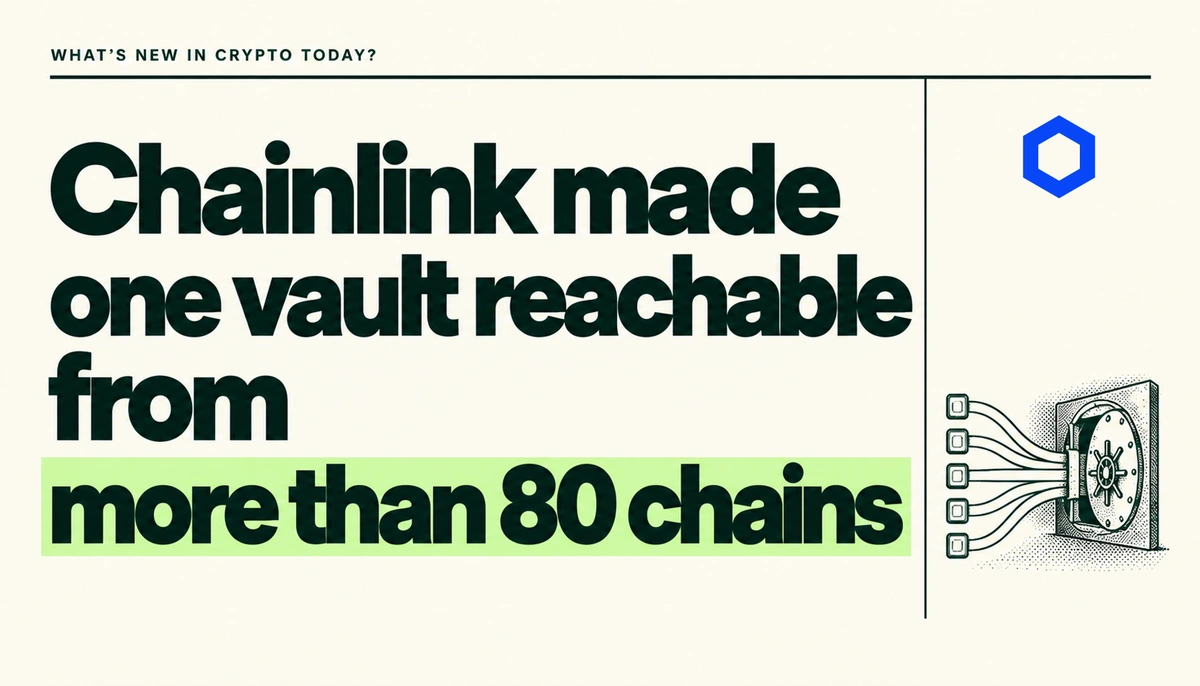
A yield vault can now stay on one chain while accepting deposits from more than 80 others.
Chainlink’s new CCIP Vault Adapters turn the usual cross-chain routine into one deposit flow. Instead of asking a user to find a bridge, change networks, swap assets and approve a vault, the adapter handles the path into the destination strategy.
Aave, Lombard and Maple are named as early adopters. The product is live as infrastructure, but Chainlink has not published adapter-specific deposit volume.
Chainlink says one vault can now receive deposits from more than 80 chains.
Chainlink (@chainlink) · October 8, 2026
The problem it removes
Imagine a user holds USDC on Base, but the vault they want lives on Ethereum.
The manual path can require several decisions: choose a bridge, move the asset, wait for settlement, change the wallet network, make another approval and then deposit. Every additional screen is a place to stop, make a mistake or choose a competing product.
With a Vault Adapter, the user starts from the source chain and chooses the vault. The routing layer handles the cross-chain movement while the vault’s strategy and accounting remain on the destination chain.
The vault provider gets a wider entrance without copying the entire product onto every network.
Why distribution matters for yield
Vaults do not compete only on returns. They compete for idle capital.
A strong strategy on one chain can still lose deposits when users hold their money somewhere else. A simpler route can make that capital reachable without fragmenting the strategy across many deployments.
That is the commercial case for the adapters. One strategy can present many front doors.
Chainlink already operates at meaningful scale across its broader protocol. DefiLlama showed about $1.91 billion in TVL and $4.45 million of 30-day fees when we checked.
Those numbers are not Vault Adapter deposits. They show the surrounding network is established, not that this new product has won usage.
One click does not remove the risk
The interface can hide several moving parts without eliminating them.
A deposit may still depend on cross-chain messaging, a bridge or liquidity route, a token swap and the destination vault’s contracts. Slippage, delayed messages, unsupported assets and contract failures can still affect the result.
Users also need to know the final cost. A convenient route can be worse than a manual path if bridge fees, swap costs and price impact consume too much of the deposit.
What would prove the adapters work
The next useful numbers are operational:
- deposits routed through the adapters;
- completed-deposit rate versus the old manual flow;
- average time and total cost by source chain;
- supported assets for each live vault;
- how much new capital comes from chains where the vault was previously hard to reach.
The product promise is simple: make every supported chain a front door to one vault. The investment question is whether that wider door produces meaningful deposits without hiding unacceptable costs or risk.
Sources and reporting notes
Checked October 8, 2026. The supported-chain count, single-chain strategy design and named adopters come from Chainlink’s announcement. The description of the manual user journey comes from Chainlink’s follow-up. Broad protocol metrics were checked on DefiLlama. We did not connect a wallet, execute a deposit or verify production status for every named integration.